

Trailer sway is not merely an annoyance; it is a critical safety hazard that claims lives and destroys vehicles every year. According to recent industry safety reports, improper towing equipment is a leading factor in fatal RV accidents, with sway-induced jackknifing accounting for a significant percentage of these tragedies. For beginners, understanding the difference between sway control and sway elimination is the first step toward responsible towing. This guide explores the engineering behind the ProPride 3P hitch, compares it against traditional friction-based systems, and provides a clear path to safe, heavy-trailer towing.
Understanding Trailer Sway Physics
Before selecting a hitch, you must understand what causes sway. Trailer sway occurs when the center of gravity of the trailer shifts behind the tow vehicle's rear axle. This creates a lever effect that amplifies small steering inputs or wind gusts into violent oscillations. For beginners, this phenomenon is often terrifying because the trailer pushes the tow vehicle rather than being pulled.
Pivot Point Projection is the core engineering principle used to counteract this physics. By positioning the pivot point of the hitch ahead of the trailer's axle centerline, the hitch forces the trailer to follow the tow vehicle's path exactly. This eliminates the lever arm that causes sway before it can start. Traditional hitches attempt to dampen sway after it has already begun, which is often too late to prevent a jackknife.
According to data from the National Highway Traffic Safety Administration, driver error and equipment failure are primary contributors to trailer-related accidents. Proper hitch selection directly mitigates these risks by stabilizing the connection point between the tow vehicle and the trailer.
Friction Bars vs. Sway Elimination
The towing industry is divided between two main technologies: friction-based sway control and sway elimination hitches. Understanding the difference is crucial for beginners towing heavy loads.
Friction-Based Sway Control
Friction bars, such as those found in the Blue Ox SwayPro or Equalizer systems, rely on tension and friction to resist lateral movement. When the trailer begins to sway, the bar tightens against the trailer frame, creating resistance. While this method is effective for minor disturbances, it has a critical flaw. It does not prevent sway; it only fights it. In high winds or during sudden lane changes, the friction can be overcome, leading to a loss of control.
Sway Elimination Hitches
Sway elimination hitches, like the ProPride 3P, use a geometric design to physically prevent the trailer from deviating from the tow vehicle's path. This is achieved through a dual-ball mount system that creates a rigid connection point. The hitch essentially turns the trailer into an extension of the tow vehicle, ensuring that the trailer wheels track directly behind the tow vehicle's rear tires.
Research indicates that sway elimination hitches provide superior stability in crosswinds and when passing large semi-trucks. For beginners, this means less physical effort and reduced anxiety on the highway.
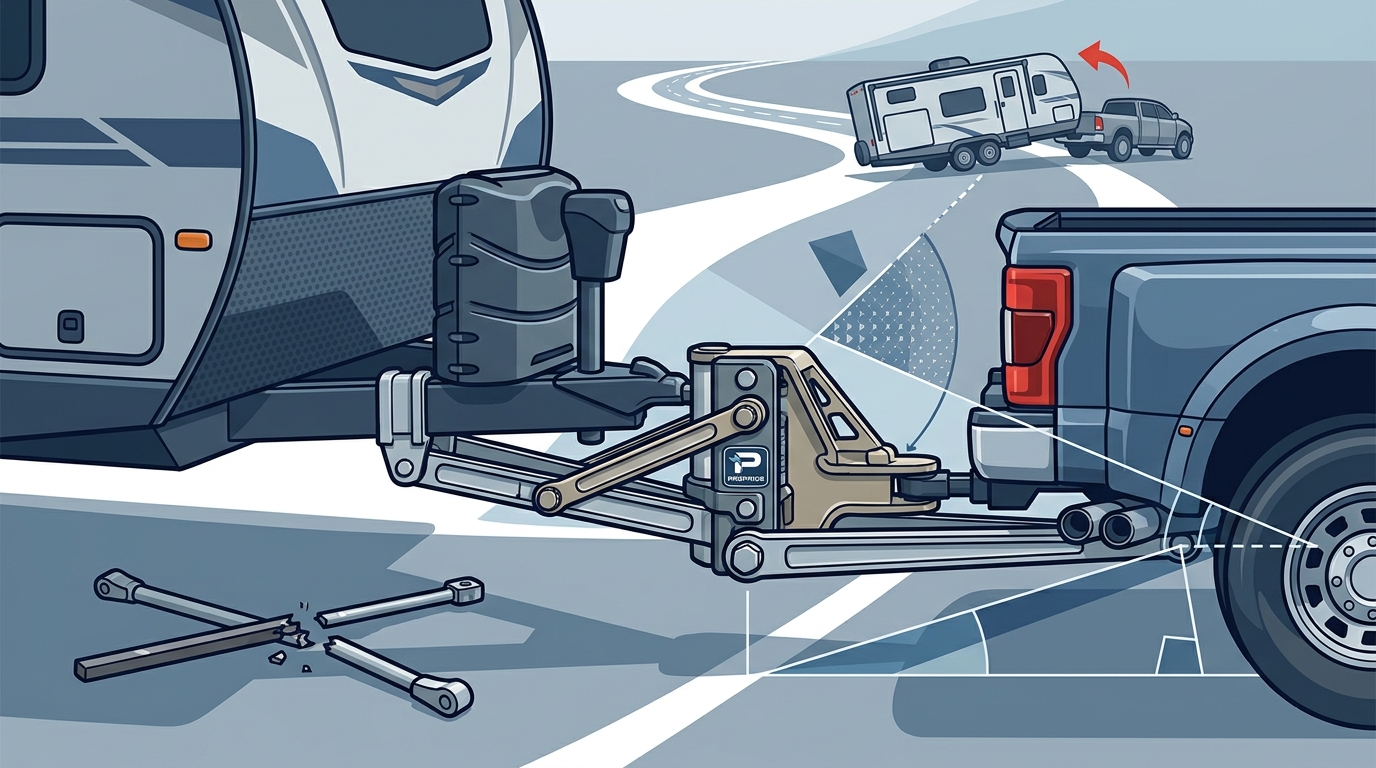
The ProPride 3P Hitch Analysis
The ProPride 3P hitch represents the evolution of Jim Hensley's original sway control designs. It is widely regarded as the gold standard for heavy trailer towing due to its robust construction and precise engineering.
Key Features of the ProPride 3P
- Pivot Point Projection: As mentioned, this feature ensures the trailer follows the tow vehicle exactly, eliminating the sway lever.
- Dual-Ball Mount: The hitch uses two balls to distribute tongue weight evenly, reducing stress on the tow vehicle's frame.
- Adjustable Tongue Weight: The ProPride 3P allows for precise adjustment of tongue weight, which is critical for maintaining proper suspension balance in the tow vehicle.
- Heavy-Duty Construction: Built from high-strength steel, the ProPride 3P is designed to handle the rigors of heavy towing without flexing or failing.
For beginners, the ProPride 3P offers a significant advantage in ease of use. Once installed and adjusted, the hitch requires no further intervention. There are no friction pads to wear out or tension bars to re-tighten. This reliability is essential for new towers who may not have the experience to diagnose equipment issues on the road.
According to customer feedback and industry reviews, the ProPride 3P is often described as making the trailer "disappear" from the driver's perspective. This sensory feedback is a strong indicator of proper sway elimination.
Competitor Comparison: Blue Ox, Equalizer, and Husky
While the ProPride 3P is a top choice, other hitches are popular among beginners. Here is a comparison of the most common alternatives.
| Hitch Model | Technology | Sway Control Method | Best For | Beginner Friendliness |
|---|---|---|---|---|
| ProPride 3P | Sway Elimination | Pivot Point Projection | Heavy trailers, Airstreams, high winds | High (Once set, it stays set) |
| Blue Ox SwayPro | Friction Control | Tension Bars | Light to medium trailers | Medium (Requires regular adjustment) |
| Equalizer Weight Distribution | Friction + Weight Distribution | Chain Tension | General RV towing | Medium (Complex setup) |
| Husky Center Line | Friction Control | Dual-Cam System | Medium trailers | Medium (Cam adjustment needed) |
As shown in the table, the ProPride 3P stands out for its elimination technology. While friction-based hitches are effective for lighter loads, they struggle with the dynamics of heavy trailers. The ProPride 3P's ability to handle tongue weights up to 1,400 pounds makes it a superior choice for heavy towing.
How to Choose the Right Hitch
Selecting the right hitch involves more than just picking a brand. You must consider your specific towing setup.
1. Calculate Your Tongue Weight
Tongue weight is the downward force exerted on the hitch ball by the trailer. For heavy trailers, this can range from 600 to 1,400 pounds. The ProPride 3P is available in 600, 800, 1000, and 1400-pound models. Choosing the correct model is critical for safety. An under-rated hitch can fail under load, while an over-rated hitch may be too stiff to handle.
2. Consider Your Tow Vehicle
Heavy hitches add weight to the rear of your tow vehicle. Ensure your vehicle's payload capacity can handle the combined weight of the hitch, the tongue weight, and any cargo. The ProPride 3P is designed to minimize this impact by distributing weight more evenly, but verification is essential.
3. Evaluate Your Towing Environment
If you frequently tow in high-wind areas or mountainous regions, sway elimination is non-negotiable. Friction-based hitches may not provide enough resistance in extreme conditions. The ProPride 3P's geometric design offers consistent performance regardless of environmental factors.
For more detailed guidance on selecting the right hitch for your specific RV, consult the ProPride Hitch Selector Guide.
Key Takeaways
- Sway Elimination is Superior: Pivot Point Projection prevents sway rather than just dampening it, offering greater safety for beginners.
- ProPride 3P is a Top Choice: The ProPride 3P hitch is engineered for heavy trailers and offers robust, maintenance-free performance.
- Tongue Weight Matters: Selecting the correct ProPride 3P model (600, 800, 1000, or 1400 lb) is critical for safe towing.
- Friction Bars Have Limits: Traditional sway control bars are effective for light loads but may fail under heavy trailer dynamics.
- Installation is Key: Proper installation ensures the hitch functions as designed. Consider using the Jim Hensley Hitch Install Network for professional setup.
- Regular Maintenance: Even sway elimination hitches require periodic inspection of bolts and pivot points to ensure safety.
- Education is Essential: Understanding towing physics, such as the Pivot Point Projection Explained, empowers beginners to tow with confidence.
Frequently Asked Questions
What is the best sway control hitch for a beginner?
The ProPride 3P hitch is widely considered the best option for beginners towing heavy trailers due to its sway elimination technology and ease of use. Unlike friction-based hitches, it requires no ongoing adjustments once installed.
How does the ProPride 3P differ from a friction sway control bar?
The ProPride 3P uses Pivot Point Projection to physically prevent the trailer from swaying, while friction bars rely on tension to resist sway after it has started. Elimination is generally safer and more effective for heavy loads.
Can I install the ProPride 3P hitch myself?
Yes, many owners install the hitch themselves using the provided 3P Assembly Videos. However, professional installation is available through the Jim Hensley Hitch Install Network for those who prefer expert assistance.
What tongue weights does the ProPride 3P support?
The ProPride 3P is available in four models: 600, 800, 1000, and 1400 pounds. You must select the model that matches your trailer's tongue weight to ensure safe towing.
Is the ProPride 3P hitch worth the cost?
Yes, the ProPride 3P is considered worth the investment due to its superior safety, durability, and performance. It eliminates the anxiety of trailer sway and provides a smoother towing experience compared to cheaper alternatives.
How do I back up with a sway elimination hitch?
Backing up with a ProPride 3P hitch requires a different technique than with standard hitches. You must use the "X