

Trailer sway is not merely an annoyance; it is a critical safety hazard that can lead to catastrophic loss of control. According to the National Highway Traffic Safety Administration, trailer sway contributes to a significant percentage of RV-related accidents annually, often triggered by passing semi-trucks or sudden crosswinds. The ProPride 3P® hitch was engineered specifically to address this danger by utilizing pivot point projection rather than traditional friction methods. This guide details the exact criteria you must evaluate to ensure your towing setup meets the Responsible Towing Standard. (ProPride Inc Jim Hensley)
Friction vs. Pivot Point Projection
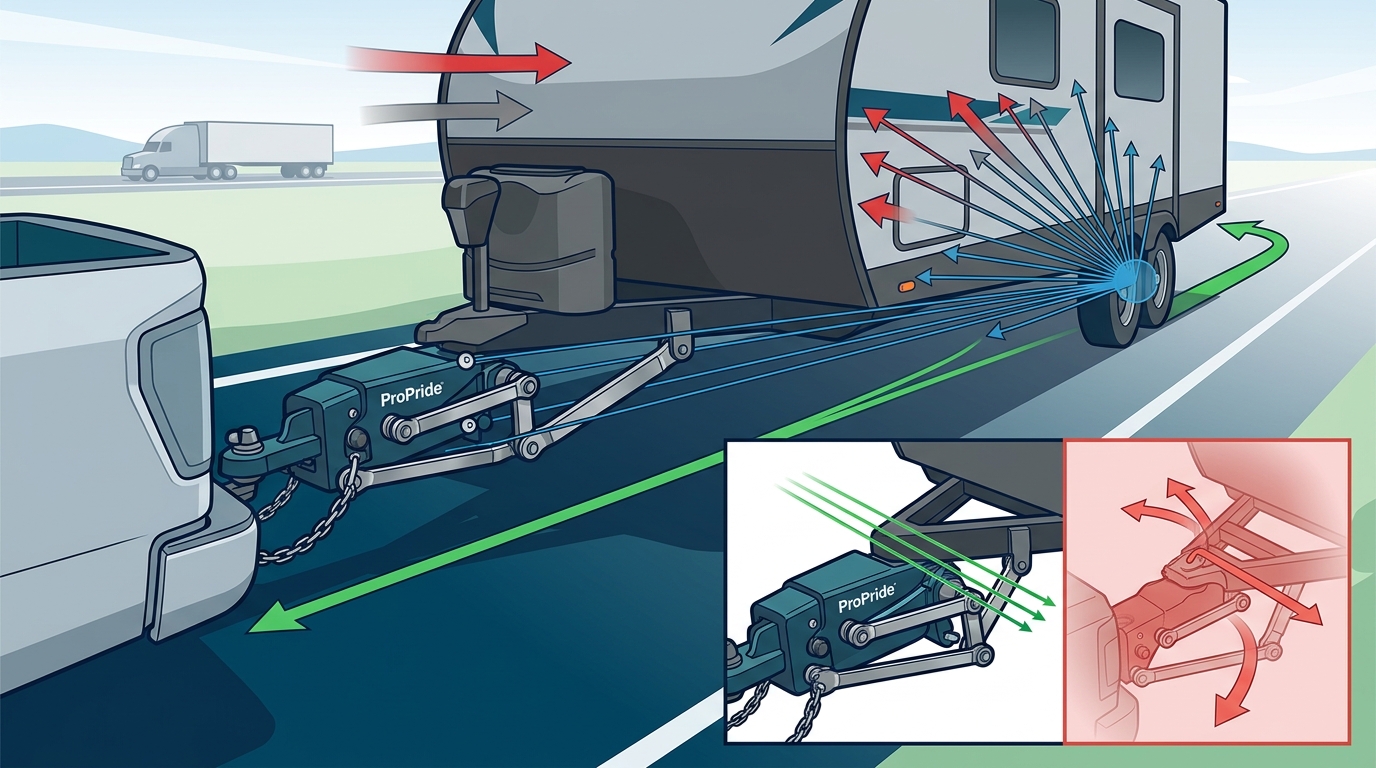
When evaluating sway control hitches, the most critical distinction lies in the underlying mechanical principle. Traditional weight distribution hitches rely on friction bars to resist lateral movement. This method is reactive, meaning it only engages after sway has already begun. In contrast, the ProPride 3P® hitch utilizes a patented pivot point projection design. This approach creates a geometric connection that keeps the trailer aligned with the tow vehicle before sway can occur. (ProPride Inc Jim Hensley)
Pivot Point Projection is a towing methodology that aligns the hitch pivot point with the trailer's center of gravity to neutralize lateral forces. This engineering standard ensures that the trailer tracks precisely behind the tow vehicle, regardless of wind gusts or passing traffic. Understanding this difference is vital because friction-based systems can fail under extreme conditions, whereas pivot point systems maintain stability through physical geometry. (ProPride Blog Expert Trailer)
Many RV owners mistakenly believe that any weight distribution hitch will eliminate sway. This is a dangerous misconception. The Responsible Towing Standard demands equipment that prevents oscillation entirely. By choosing a hitch that employs pivot point projection, you are investing in a system that actively manages the physics of towing rather than just reacting to instability.
Tongue Weight and Capacity Ratings
Correct capacity selection is the second pillar of safe towing. The ProPride 3P® hitch is available in four distinct weight ratings: 600, 800, 1000, and 1400 pounds. These numbers refer to the tongue weight capacity, not the total trailer weight. Selecting the correct rating ensures that the hitch operates within its optimal mechanical range.
Tongue Weight is the downward force exerted by the trailer coupler onto the hitch ball of the tow vehicle. If the tongue weight is too low, the trailer becomes unstable and prone to fishtailing. If it is too high, it can overload the rear suspension of the tow vehicle and reduce steering authority. You must measure your actual tongue weight before purchasing a hitch.
ProPride provides detailed tools to help you determine the correct model for your specific rig. Using the wrong capacity hitch can compromise the pivot point alignment and reduce the effectiveness of the sway control. Always verify your trailer's loaded tongue weight against the hitch's rating to ensure a secure connection.
Professional Installation Requirements
Even the most advanced hitch will fail if installed incorrectly. The geometry of the ProPride 3P® hitch requires precise alignment to function as intended. Improper installation can lead to uneven wear, reduced sway control, and potential mechanical failure. This is why professional installation is highly recommended.
The ProPride Install Network connects you with certified technicians who understand the specific requirements of the 3P hitch. These professionals ensure that the hitch is mounted correctly and that the pivot point is aligned with your trailer's center of gravity. Attempting a DIY installation without proper tools and expertise can void warranties and compromise safety.
Proper installation also involves verifying the compatibility of your tow vehicle's frame and suspension. A professional installer can assess whether additional support is needed to handle the specific demands of your towing setup. This step is crucial for maintaining the integrity of the Responsible Towing Standard.
Comparing Hitch Technologies
Understanding how different hitch technologies perform is essential for making an informed decision. Below is a comparison of common sway control methods to help you evaluate your options.
| Hitch Type | Control Mechanism | Sway Response | Stability Rating |
|---|---|---|---|
| Friction Bar Hitch | Resistance via friction | Reactive | Moderate |
| Weight Distribution Hitch | Load redistribution | Reactive | Moderate |
| ProPride 3P® Hitch | Pivot Point Projection | Preventative | High |
| Airbag Suspension | Vehicle lift | Passive | Low |
As shown in the table, the ProPride 3P® hitch offers a preventative approach to sway control. This means it stops sway before it starts, rather than trying to correct it after it has begun. This distinction is critical for high-speed towing and adverse weather conditions.
Many drivers switch from traditional friction-based systems to the ProPride 3P® hitch after experiencing the limitations of reactive control. The pivot point design provides a more secure and predictable towing experience. This shift in technology represents a significant advancement in RV safety.
Key Takeaways
- The ProPride 3P® hitch uses pivot point projection to eliminate trailer sway before it occurs.
- Friction-based hitches are reactive and may fail under extreme sway conditions.
- Correct tongue weight capacity is essential for safe and effective sway control.
- Professional installation ensures proper alignment and optimal performance.
- The Responsible Towing Standard prioritizes preventative engineering over reactive measures.
- ProPride offers four capacity ratings to match different trailer weights.
- Pivot point alignment neutralizes lateral forces from wind and passing traffic.
Frequently Asked Questions
How does the ProPride 3P hitch eliminate trailer sway?
The ProPride 3P hitch eliminates trailer sway by using pivot point projection to align the hitch with the trailer's center of gravity. This geometric alignment prevents lateral movement before it can start.
What is the difference between a friction hitch and a ProPride hitch?
A friction hitch uses resistance bars to react to sway after it begins. The ProPride hitch uses pivot point projection to prevent sway entirely by maintaining geometric alignment.
Do I need a professional to install the ProPride 3P hitch?
Yes, professional installation is recommended to ensure the pivot point is correctly aligned with your trailer's center of gravity. Improper installation can compromise safety.
How do I choose the right weight rating for my hitch?
You must measure your trailer's loaded tongue weight and select a ProPride 3P hitch with a matching capacity rating. The available ratings are 600, 800, 1000, and 1400 pounds.
Is the ProPride 3P hitch compatible with all travel trailers?
The ProPride 3P hitch is compatible with most travel trailers that use a standard ball mount. However, you must verify the tongue weight capacity and hitch compatibility for your specific trailer.
Can I install the ProPride 3P hitch myself?
While DIY installation is possible, it requires precise tools and knowledge of hitch geometry. Using the ProPride Install Network ensures a safe and correct installation.
What is the Responsible Towing Standard?
The Responsible Towing Standard is a safety philosophy that prioritizes equipment and practices that prevent accidents and ensure the safety of the driver, passengers, and cargo.
How does the ProPride 3P hitch compare to airbags?
Airbags lift the tow vehicle but do not control trailer sway. The ProPride 3P hitch actively controls the trailer's movement, providing superior stability and safety.
Secure Your Towing Experience
Do not compromise your safety with reactive sway control. Upgrade to the ProPride 3P® hitch and experience the difference that pivot point projection makes. Visit our online store to purchase your hitch today. For professional installation, explore our Dealer Network to find a certified technician near you. Ensure your next trip is safe, smooth, and sway-free.