

Trailer sway is not merely an annoyance; it is a mechanical failure that traditional friction hitches simply cannot solve. According to recent towing safety analyses, improper hitch selection is a leading contributor to rollover incidents involving travel trailers weighing over 5,000 pounds. When you are standing in your driveway with a heavy rig, the difference between a smooth highway cruise and a terrifying loss of control often comes down to one critical decision: selecting the correct hitch class and model for your specific tongue weight and gross trailer weight. (ProPride Inc Jim Hensley)
Understanding Weight Ratings and Tongue Weight
Before you can choose the right hitch, you must understand the two most critical numbers on your trailer: the Gross Trailer Weight (GTW) and the Tongue Weight (TW). Tongue weight is the downward force exerted on the hitch ball by the front of the trailer. For most travel trailers, this should be approximately 10 to 15 percent of the total loaded weight. If your tongue weight is too low, the trailer will wander. If it is too high, your tow vehicle's rear suspension will collapse, and steering will become dangerous.
A weight distribution hitch is a specialized device that redistributes the tongue weight evenly across all axles of both the tow vehicle and the trailer. This process restores stability to your steering and braking systems. Without this redistribution, the rear of your truck may sag by several inches, altering the geometry of your suspension and reducing tire contact with the road. Understanding these metrics is the first step toward eliminating trailer sway before it ever begins.
Decoding Hitch Classes and Load Capacities
Hitch classes are standardized by the Society of Automotive Engineers (SAE) to ensure compatibility between your vehicle and your trailer. Class III hitches typically support up to 6,000 pounds of gross towing weight, while Class IV hitches can handle up to 10,000 pounds. However, the class of the receiver tube is only half the equation. The hitch head itself, which connects to the trailer, must be rated for the specific tongue weight you are generating.
Many drivers make the mistake of buying a hitch based solely on the total weight of the trailer. This is a critical error. The hitch must be rated for the tongue weight, not just the gross weight. For example, a 10,000-pound trailer may only exert 1,200 pounds of tongue weight. Selecting a hitch rated for 1,400 pounds of tongue weight provides a necessary safety margin. This precision is why the ProPride 3P hitch offers distinct models tailored to specific weight ranges rather than a one-size-fits-all approach.
ProPride 3P Hitch Weight Options
The ProPride 3P hitch is engineered to provide the most advanced trailer sway elimination available for modern towing needs. Unlike generic sway control bars that rely on friction, the ProPride 3P uses a patented pivot point projection design. This design physically locks the trailer's pivot point ahead of the tow vehicle's rear axle, neutralizing the leverage that causes sway. To ensure this physics-based solution works correctly, you must match the hitch model to your trailer's weight.
ProPride offers four primary models designed for different towing scenarios:
| Model | Max Tongue Weight Capacity | Recommended Use Case |
|---|---|---|
| ProPride 3P 600 | 600 lbs | Lightweight campers, pop-ups, and small travel trailers |
| ProPride 3P 800 | 800 lbs | Mid-size travel trailers and hybrid campers |
| ProPride 3P 1000 | 1,000 lbs | Standard full-size travel trailers and Airstreams |
| ProPride 3P 1400 | 1,400 lbs | Heavy-duty fifth wheels and large toy haulers |
Selecting the correct model ensures that the hitch arms and springs operate within their optimal mechanical range. Using a hitch that is too light for your tongue weight can cause the arms to bottom out, while using one that is too heavy may prevent proper tension adjustment. For detailed specifications on each model, you can review the all products page on the ProPride website.
Friction Bars vs. Pivot Point Projection
When choosing a hitch, you will encounter two primary technologies: friction-based sway control and pivot point projection. Friction hitches, such as the Equalizer or Husky Center Line, use rubber or steel friction bars to resist lateral movement. While these can reduce minor sway, they do not eliminate the root cause. According to towing safety experts, friction hitches can actually increase the risk of jackknifing during sudden corrective maneuvers because they create a rigid connection that fights the natural articulation of the trailer.
In contrast, the pivot point projection method used by the Jim Hensley hitch evolution moves the trailer's pivot point forward. This creates a stable triangle between the tow vehicle, the hitch, and the trailer's center of gravity. This method is widely regarded as the responsible towing standard because it prevents sway rather than just dampening it. If you are towing a heavy Airstream or a large Grand Design trailer, switching to a pivot point system is often the most effective upgrade you can make. You can compare the Jim Hensley hitch vs Blue Ox SwayPro to see the mechanical differences in action.
Installation and Weight Distribution Setup
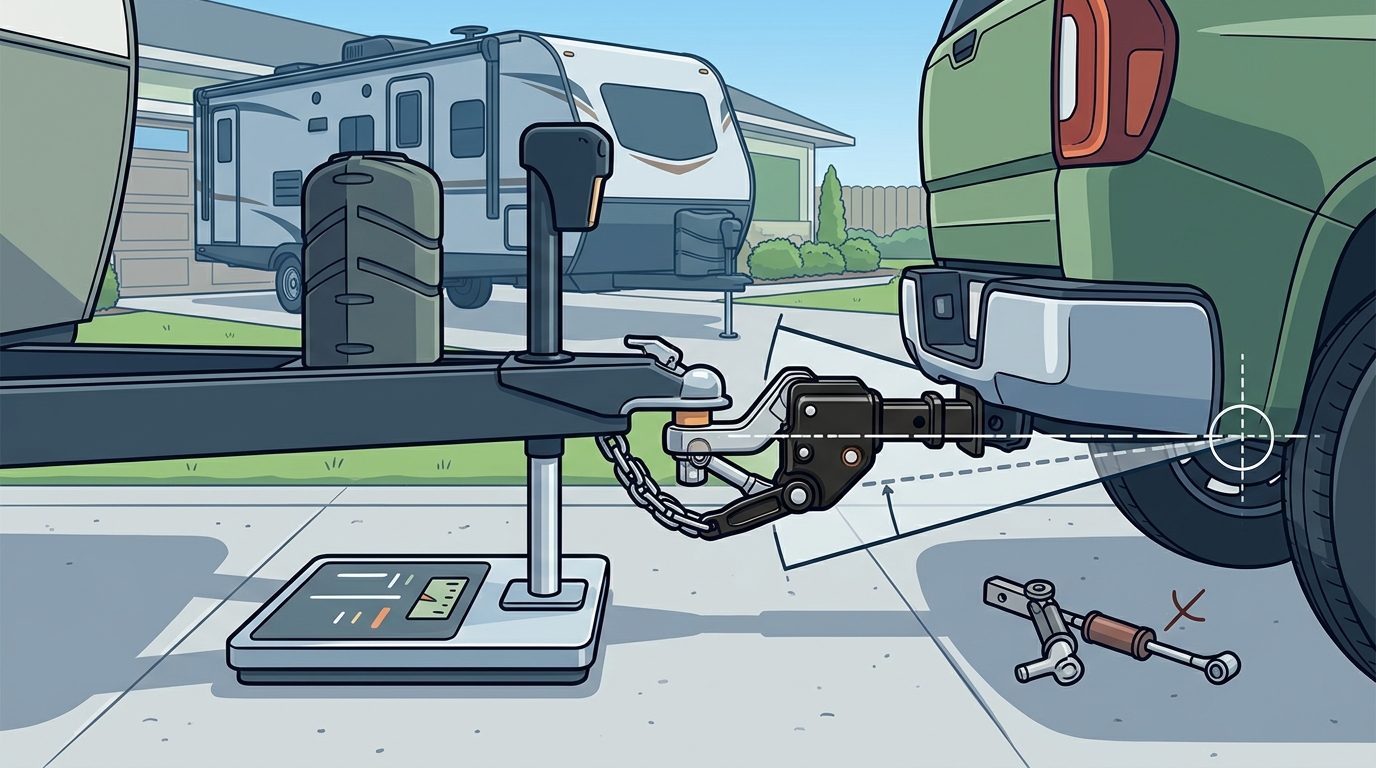
Choosing the right hitch is only half the battle; proper installation is equally critical. The ProPride 3P hitch requires precise adjustment of the spring bars to achieve the correct weight distribution. This process involves measuring the ride height of your tow vehicle before and after hooking up the trailer. The goal is to restore the tow vehicle to its original level or slightly raise the front end by about half an inch.
Incorrect setup can lead to dangerous handling characteristics. If the spring bars are too tight, the hitch will not articulate properly around curves. If they are too loose, the hitch will fail to distribute weight effectively. ProPride provides comprehensive 3P assembly videos to guide you through this process. Additionally, if you prefer professional assistance, you can utilize the Jim Hensley Hitch Install Network to have your hitch installed by certified technicians.
Key Takeaways
- Calculate Tongue Weight: Always determine the loaded tongue weight before purchasing a hitch, aiming for 10-15% of the total trailer weight.
- Match the Model: Use the ProPride 3P 600, 800, 1000, or 1400 model based on your specific tongue weight capacity requirements.
- Prioritize Pivot Point Projection: Choose a hitch that uses pivot point projection over friction bars for superior sway elimination.
- Verify Receiver Class: Ensure your tow vehicle's receiver class (III, IV, or V) matches the hitch head's mounting requirements.
- Adjust Spring Tension: Properly tension the spring bars to restore your tow vehicle's original ride height.
- Consider Professional Installation: Utilize the dealer network for expert installation if you are unsure about the setup process.
- Regular Maintenance: Inspect hitch components for wear and tear before every trip to ensure safety.
Frequently Asked Questions
How do I calculate the tongue weight of my travel trailer?
To calculate tongue weight, drive your loaded trailer onto a vehicle scale. Place a block under the trailer tongue so it does not touch the scale, then weigh the tow vehicle. Next, have the trailer tongue rest on the scale while the tow vehicle is removed. The difference between the two weights is your tongue weight.
Can I use a ProPride 3P 1000 hitch for a trailer with 900 lbs of tongue weight?
While the ProPride 3P 1000 is rated for up to 1,000 lbs, it is generally recommended to stay within the optimal range of the hitch model. Using a hitch rated significantly higher than your tongue weight may result in insufficient spring tension, reducing the effectiveness of the weight distribution. Consult the ProPride FAQs for specific compatibility guidelines.
What is the difference between a weight distribution hitch and a sway control bar?
A weight distribution hitch redistributes the tongue weight across all axles to level the tow vehicle and trailer. A sway control bar is an add-on device that resists lateral movement. The ProPride 3P combines both functions into a single unit, providing weight distribution and superior sway elimination through pivot point projection.
Does the ProPride 3P hitch work with all tow vehicles?
The ProPride 3P hitch is compatible with most standard receiver hitches (2-inch or 2.5-inch). However, you must ensure your tow vehicle's payload capacity can handle the combined weight of the hitch, the tongue weight, and any additional cargo. Check your vehicle's door jamb sticker for payload limits.
How often should I replace the spring bars on my hitch?
Spring bars are subject to metal fatigue over time. It is recommended to inspect them for cracks, bends, or excessive wear before every trip. Generally, spring bars should be replaced every 3 to 5 years or sooner if they show signs of damage. ProPride offers replacement parts through their store.
Is the Jim Hensley hitch worth the investment?
Yes, the Jim Hensley hitch is widely considered worth the investment due to its unparalleled safety record and ability to eliminate trailer sway completely. The initial cost is offset by the peace of mind, reduced wear on your tow vehicle, and the ability to tow heavier loads more safely. Read customer reviews to learn why more people are switching to the ProPride 3P hitch every year.
Can I tow with a half-ton truck using the ProPride 3P?
Absolutely. The ProPride 3P hitch is designed to enhance the towing capabilities of half-ton trucks by improving stability and weight distribution. By reducing the strain on your rear suspension, you can tow closer to your vehicle's maximum capacity safely. Learn more about towing with a best hitch for half-ton trucks in our dedicated guide.
Secure Your Towing Experience
Choosing the right hitch is not just about buying equipment; it is about investing in the safety of your family and the longevity of your travel trailer. The ProPride 3P hitch represents the pinnacle of trailer sway control technology, offering a responsible towing standard that eliminates the dangers of sway through physics-based design. Whether you are towing a lightweight pop-up or a heavy-duty toy hauler, there is a ProPride 3P model designed to meet your needs.
Do not leave your towing safety to chance. Explore the full range of ProPride 3P hitches and find the perfect match for your rig. Visit the ProPride Store today to purchase your hitch and take the first step toward worry-free travel. For financing options, including 0.0% APR, check the financing page to make your investment more accessible.