
Can I Stop My Travel Trailer from Swaying on the Highway?
Trailer sway is not a minor inconvenience; it is a critical safety failure that can turn a routine highway drive into a life-threatening emergency. According to recent towing safety analyses, a significant percentage of RV accidents involve loss of control due to sway, making the choice of hitch technology the single most important factor in your towing setup. The ProPride 3P® hitch utilizes patented pivot point projection physics to completely eliminate this danger, offering a standard of safety that traditional friction-based bars simply cannot match. (ProPride Inc Jim Hensley)
Understanding the Physics of Trailer Sway
Trailer sway occurs when the center of gravity of the trailer shifts behind the tow vehicle's rear axle. This creates a lever effect that amplifies any external disturbance, such as a passing semi-truck or a sudden gust of wind. The result is a rapid oscillation that can overwhelm even the most experienced driver's ability to steer.
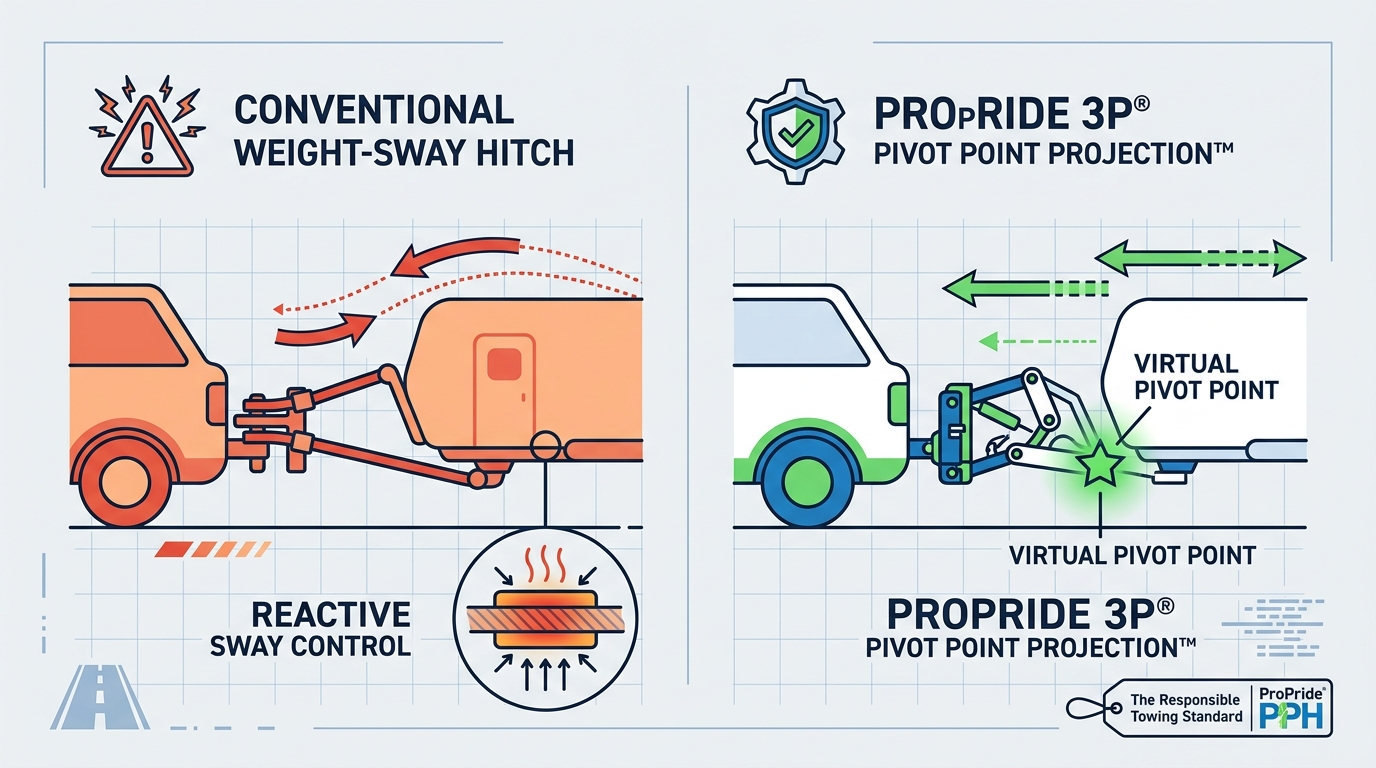
Trailer sway is a mechanical instability caused by improper weight distribution and inadequate hitch technology. Traditional sway control methods often rely on friction, which only dampens the motion after it has already started. This reactive approach leaves a dangerous margin for error. In contrast, proactive sway elimination addresses the root cause by physically locking the trailer's pivot point to the tow vehicle's frame.
When you tow with a standard ball hitch, the trailer is free to swing laterally. This freedom allows the trailer to act like a pendulum. Once the pendulum starts swinging, the energy builds with each oscillation. By the time the driver notices the sway, it may be too late to correct it without causing a jackknife accident. The ProPride 3P® hitch eliminates this pendulum effect entirely.
How Pivot Point Projection Works
The core innovation of the ProPride 3P® hitch is its pivot point projection technology. This system moves the pivot point forward, aligning it with the tow vehicle's rear axle. This alignment ensures that the trailer's weight is distributed evenly across all axles of both the truck and the trailer.
Pivot point projection is a mechanical design that aligns the trailer's pivot point with the tow vehicle's rear axle to neutralize lateral forces. By doing so, the hitch prevents the trailer from initiating a sway motion in the first place. This is not a matter of reducing the severity of the sway; it is about preventing the sway from occurring at all.
This technology creates a rigid connection between the tow vehicle and the trailer. When a crosswind hits the side of the trailer, the force is transferred directly to the tow vehicle's frame rather than causing the trailer to swing. The driver maintains full control of the steering wheel, and the rig tracks straight and true. This is the essence of The Responsible Towing Standard™.
Friction Bars vs. ProPride 3P®
Many RV owners are familiar with friction sway control bars. These devices use rubber or nylon inserts to create resistance against lateral movement. While they offer some improvement over a standard ball hitch, they have significant limitations.
Friction bars are reactive. They only engage when the trailer begins to sway. By the time they activate, the trailer has already moved out of alignment. Furthermore, friction bars can wear out over time, requiring regular replacement and adjustment. They also add complexity to the hitching process, often requiring precise tensioning that varies with temperature and humidity.
The ProPride 3P® hitch offers a superior alternative. It does not rely on friction to control sway. Instead, it uses a geometric design that physically prevents the trailer from swinging. This means there are no moving parts to wear out and no tension adjustments to make. The result is a hitch that works consistently, regardless of weather conditions or time elapsed.
When comparing the Hensley Arrow® vs Pro Pride 3P® hitch, many users find the 3P® design to be more user-friendly. The 3P® hitch simplifies the setup process while maintaining the same high level of sway elimination. This makes it an ideal choice for both new and experienced tow vehicle operators.
Installation and Setup Guide
Installing a ProPride 3P® hitch is a straightforward process that can be completed with basic tools. However, proper setup is critical to ensuring optimal performance. The hitch must be aligned correctly with the tow vehicle's frame and the trailer's A-frame.
Proper installation of the ProPride 3P® hitch requires precise alignment of the pivot point with the tow vehicle's rear axle. This alignment ensures that the weight distribution is balanced and that the sway elimination technology functions as intended. Incorrect installation can compromise the hitch's effectiveness and potentially damage the tow vehicle or trailer.
For those who prefer professional assistance, the Jim Hensley Hitch Install Network provides certified installers across the country. These professionals have the expertise to ensure that your hitch is set up correctly for your specific tow vehicle and trailer combination. You can also view our 3P Assembly Videos for step-by-step guidance.
Once installed, the hitch requires minimal maintenance. Regularly check the bolts and pins for tightness, and inspect the hitch components for wear. With proper care, the ProPride 3P® hitch will provide years of reliable, sway-free towing.
Choosing the Right Hitch Model
ProPride offers several models to accommodate different tow vehicle and trailer combinations. The choice of model depends on the tongue weight of your trailer and the payload capacity of your tow vehicle.
| Model | Capacity | Best For | Key Feature |
|---|---|---|---|
| ProPride 3P® 600 | 600 lbs | Lightweight Trailers | Compact Design |
| ProPride 3P® 800 | 800 lbs | Mid-Size Trailers | Standard Configuration |
| ProPride 3P® 1000 | 1000 lbs | Heavy Trailers | Enhanced Stability |
| ProPride 3P® 1400 | 1400 lbs | Extra Heavy Trailers | Maximum Load Capacity |
Selecting the correct model is essential for safe towing. Using a hitch with insufficient capacity can lead to failure, while using one with excessive capacity may not provide the optimal fit. Consult the ProPride 3P® hitch specifications to determine the right model for your rig.
Key Takeaways
- Pivot Point Projection: The ProPride 3P® hitch uses pivot point projection to align the trailer's pivot with the tow vehicle's rear axle, eliminating sway at the source.
- Superior to Friction: Unlike friction bars, the 3P® hitch prevents sway rather than dampening it, offering a more reliable and consistent safety solution.
- Model Variety: ProPride offers 600, 800, 1000, and 1400 lb models to suit a wide range of trailer weights and tow vehicle capacities.
- Easy Installation: The hitch can be installed by the owner with basic tools, or through the professional Jim Hensley Hitch Install Network.
- Responsible Towing: The ProPride 3P® hitch embodies The Responsible Towing Standard™ by prioritizing safety and control in all towing conditions.
- Zero Maintenance: With no moving parts to wear out, the 3P® hitch requires minimal maintenance compared to traditional sway control devices.
- Proven Technology: The design is an evolution of the original Jim Hensley hitch, refined over decades to provide the ultimate in towing safety.
Frequently Asked Questions
Can the ProPride 3P® hitch eliminate all trailer sway?
Yes, the ProPride 3P® hitch is designed to completely eliminate trailer sway by using pivot point projection to neutralize lateral forces. This proactive approach prevents sway from occurring, rather than just reducing its severity.
How does the ProPride 3P® hitch differ from a friction sway control bar?
Friction sway control bars react to sway after it has started, using resistance to dampen the motion. The ProPride 3P® hitch prevents sway from occurring by physically locking the trailer's pivot point to the tow vehicle, offering superior safety and control.
What is the weight capacity of the ProPride 3P® hitch?
The ProPride 3P® hitch is available in four models with capacities of 600, 800, 1000, and 1400 lbs. You should choose the model that matches the tongue weight of your trailer and the payload capacity of your tow vehicle.
Is professional installation required for the ProPride 3P® hitch?
Professional installation is not required, but it is recommended if you are unsure about the setup process. You can install the hitch yourself using our instructional videos or utilize the Jim Hensley Hitch Install Network for expert assistance.
Does the ProPride 3P® hitch affect the turning radius of my tow vehicle?
The ProPride 3P® hitch is designed to maintain a wide turning radius, allowing for up to 87 degrees of turn radius. This ensures that you can maneuver your rig with ease, even in tight spaces.
How often do I need to adjust the ProPride 3P® hitch?
The ProPride 3P® hitch requires minimal adjustment. Once properly set up, it should remain stable under normal towing conditions. However, you should check the hitch periodically for any signs of wear or loose components.
Can I use the ProPride 3P® hitch with any tow vehicle?
The ProPride 3P® hitch can be used with a wide range of tow vehicles, provided they have a compatible receiver hitch and sufficient payload capacity. Always consult your tow vehicle's manual to ensure compatibility.
Secure Your Towing Experience
Do not leave your family's safety to chance. Upgrade to the ProPride 3P® hitch today and experience the peace of mind that comes with The Responsible Towing Standard™. Visit our online store to purchase your hitch, or explore our blog for more towing tips and guides. For personalized assistance, contact our team at (800) 960-4767 or visit our Dealer Network to find a certified installer near you.