

Trailer sway is not a minor inconvenience; it is a mechanical failure that traditional friction hitches simply cannot solve. If you have ever felt the sickening tug of a passing semi-truck or the physical exhaustion of making constant steering corrections during a long haul, you know that "good enough" equipment is not an option when your family's safety is on the line. You are the kind of driver who does the research because you understand that hope is not a safety strategy. This guide explains how to achieve the Responsible Towing Standard by eliminating sway entirely rather than just managing it. (ProPride Inc Jim Hensley)
Understanding the Physics of Trailer Sway
Trailer sway occurs when the center of gravity of the trailer shifts behind the tow vehicle's rear axle. This creates a lever effect that amplifies small steering inputs or wind gusts into violent oscillations. According to towing safety data, sway incidents often escalate rapidly, leaving drivers with little time to react. Traditional sway control methods rely on friction to dampen these movements, but friction is a reactive measure. It only works after the sway has already begun.
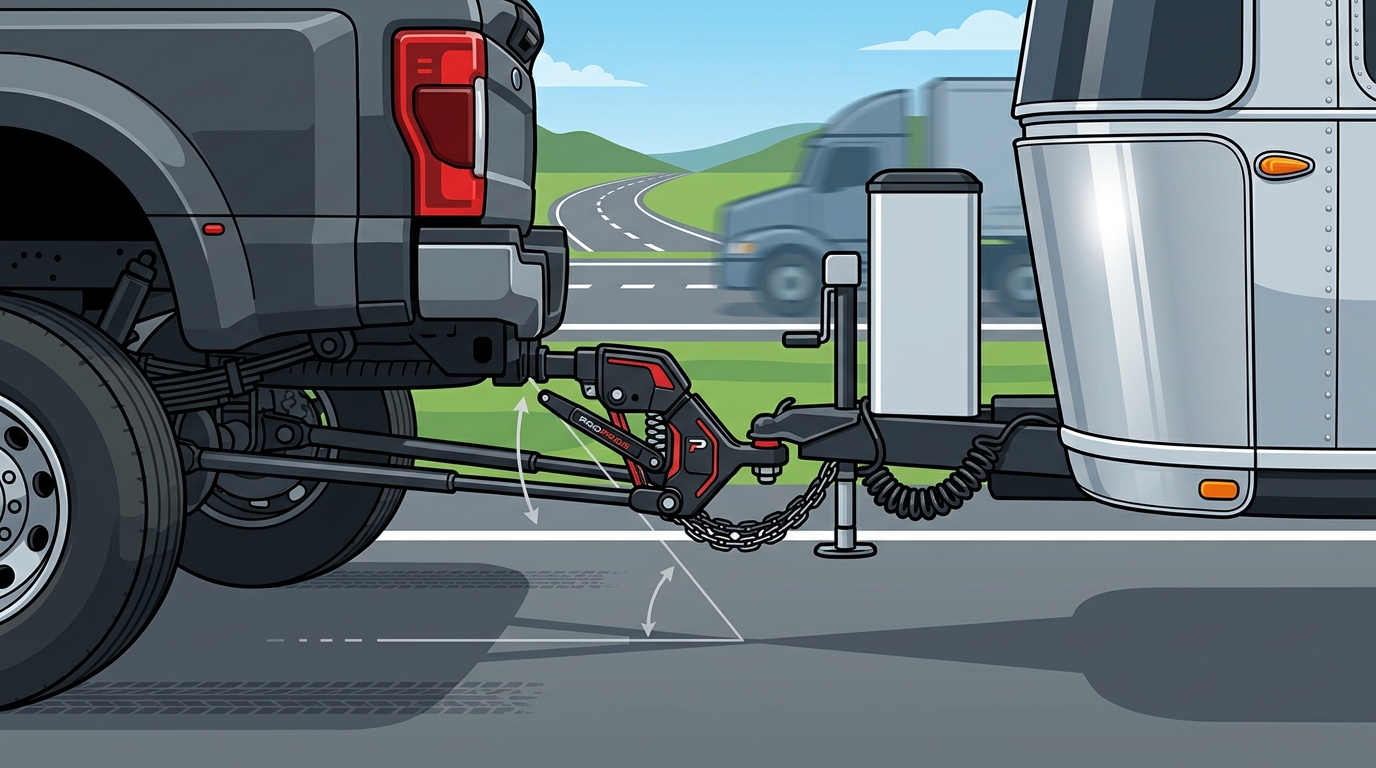
The ProPride 3P hitch uses physics to completely eliminate trailer sway by changing the geometry of the connection point. This approach addresses the root cause of instability rather than just treating the symptoms. By repositioning the pivot point, the hitch ensures that the trailer follows the tow vehicle's path precisely, regardless of external forces.
Pivot Point Projection Explained
Pivot Point Projection is the core technology behind the ProPride 3P hitch. This method moves the pivot point forward of the trailer's axle center. When the pivot point is positioned correctly, the trailer becomes mechanically linked to the tow vehicle in a way that prevents lateral movement.
This is different from a standard weight distribution hitch, where the pivot point is typically at or behind the axle. By projecting the pivot point forward, the hitch creates a stabilizing force that counteracts any attempt by the trailer to swing out of line. This results in a towing experience that feels more like driving a fifth-wheel trailer than a travel trailer.
The Evolution to ProPride 3P
Jim Hensley revolutionized the sway control hitch with his original Hensley Eliminator. He continued improving his concept with the Hensley Arrow hitch. Finally, in his never-ending quest for the most complete, hassle-free, user-friendly hitch, he improved the Hensley Hitch in the ProPride 3P design. This evolution represents decades of engineering refinement aimed at eliminating the dangers associated with trailer sway.
The ProPride 3P hitch is available in 600, 800, 1000, and 1400lb options. These ratings ensure that owners of various Airstream models, from the compact 16-foot to the larger 30-foot units, can find a hitch that matches their specific weight requirements. The hitch is designed to work seamlessly with half-ton trucks, which are among the most popular tow vehicles in North America.
Installation and Setup Protocols
Proper installation is critical for the ProPride 3P hitch to function correctly. The hitch must be aligned precisely with the trailer's centerline and the tow vehicle's receiver. Incorrect alignment can compromise the pivot point projection and reduce the hitch's effectiveness.
Weight distribution adjustment is another vital aspect of setup. Many drivers mistakenly treat their hardware as a set-it-and-forget-it solution. In reality, any change in your trailer's cargo or your truck's payload shifts your center of gravity and demands a precise mechanical response. You can learn more about the Responsible Towing Standard checklist for 2026 to ensure your setup is optimal.
If you prefer professional assistance, you can utilize the Jim Hensley Hitch Install Network. Having your hitch installed by a professional ensures that all mechanical components are secured correctly and that the hitch is calibrated to your specific vehicle and trailer combination.
ProPride 3P vs. Friction Bars
Traditional sway control hitches use friction bars to resist lateral movement. While these can reduce the amplitude of sway, they do not eliminate it. Friction bars also require regular maintenance and adjustment as the friction surfaces wear down over time. In contrast, the ProPride 3P hitch uses a mechanical linkage system that requires no adjustment once properly set up.
Here is a comparison of the two approaches:
| Feature | ProPride 3P Hitch | Traditional Friction Hitch |
|---|---|---|
| Sway Elimination | Complete elimination via pivot point projection | Reduction only; sway may still occur |
| Maintenance | Low; no moving friction parts | High; requires regular bar adjustment |
| Towing Feel | Stable, like a fifth-wheel | Can feel tight or restrictive |
| Installation Complexity | Requires precise alignment | Generally simpler but less effective |
For those interested in the technical details, you can read more about how the Jim Hensley Hitch works and the patented design that makes it unique. Understanding the difference between friction and pivot point projection is key to making an informed decision.
Key Takeaways
- The ProPride 3P hitch eliminates trailer sway using pivot point projection, not friction.
- Jim Hensley's original Hensley Eliminator laid the groundwork for modern sway control technology.
- The hitch is available in 600, 800, 1000, and 1400lb weight ratings.
- Proper weight distribution adjustment is essential for optimal towing performance.
- The ProPride 3P hitch improves stability for half-ton trucks towing Airstream trailers.
- Professional installation is available through the Jim Hensley Hitch Install Network.
- Pivot Point Projection is the mechanism that prevents lateral trailer movement.
Frequently Asked Questions
What is a Jim Hensley Hitch?
A Jim Hensley Hitch is a type of weight distribution hitch that uses pivot point projection to eliminate trailer sway. It is designed to provide a safer and more stable towing experience compared to traditional friction-based hitches.
How does a Jim Hensley Hitch Affect Tongue Weight?
The hitch redistributes tongue weight across the axles of both the tow vehicle and the trailer. This improves steering control and reduces rear-end sag, leading to better overall vehicle handling.
Is a Friction-Based Solution as Safe as a Jim Hensley Hitch?
No, friction-based solutions are not as safe because they only reduce sway rather than eliminate it. The ProPride 3P hitch uses mechanical linkage to prevent sway entirely, offering superior safety.
How To Back Up With A Jim Hensley Hitch?
Backing up with a ProPride 3P hitch requires a different technique than with standard hitches. You can enjoy up to 87 degrees of turn radius, but you must use specific backing techniques to avoid damaging the hitch or trailer.
What Jim Hensley Hitch Do I Need For My Airstream?
The correct hitch depends on the gross trailer weight and tongue weight of your specific Airstream model. You can choose the perfect hitch by consulting the weight ratings available on the store page.
How Much Does The Jim Hensley Hitch Weigh?
Hitch weight varies by model, but the ProPride 3P is designed to be robust yet manageable. The weight influences tongue weight and must be accounted for when calculating your tow vehicle's payload capacity.
Where To Buy The Jim Hensley Hitch?
You can purchase the ProPride 3P hitch directly from the official store. The store offers various models and accessories to ensure you have everything needed for a safe towing experience.
Secure Your Towing Experience
Don't leave your safety to chance. Upgrade to the ProPride 3P hitch and experience the Responsible Towing Standard. Visit the ProPride Store to buy your hitch today. You can also learn more about our 0.0% APR financing options to make your investment more manageable. For additional support, check out the ProPride Blog for expert tips and guides.